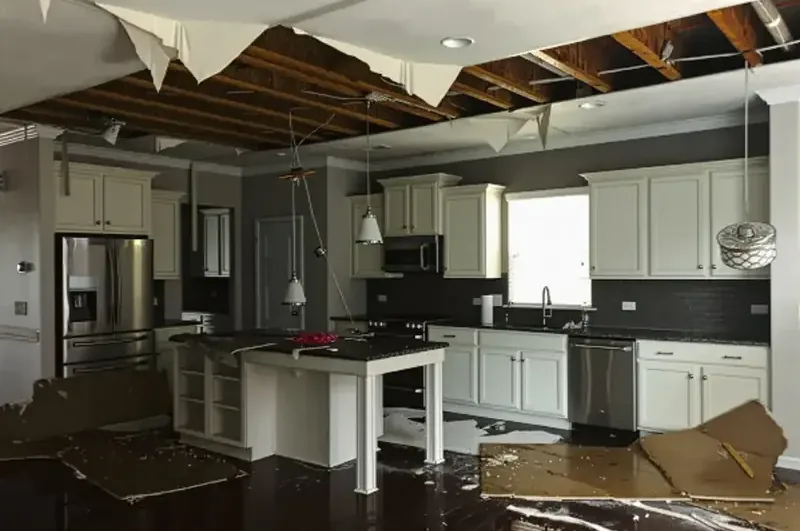
Las Flores is an unincorporated community with single-family neighborhoods and condominium neighborhoods. In shared buildings, a leak upstairs becomes a ceiling problem for the unit below.
Key takeaways
- Las Flores has condominium neighborhoods, including Magnolia Lane and SeaCountry.
- A washer hose, dishwasher or shower upstairs can send water through the floor into the ceiling below.
- The owner of the leaking unit, the neighbor below and the building association all need to be told.
- Ceiling drywall is opened and joist bays are dried to stop hidden damage.
- Photos and dates from both units help with insurance.
How an upstairs leak becomes a downstairs ceiling stain
Water from a failed hose, a supply fitting or an overflowing tub moves down. It seeps through the subfloor, soaks the insulation and shows up as a stain.
By the time a stain appears, the ceiling cavity is usually wet and the floor above may be wet too.
A slow leak can drip for weeks. The ceiling may hold the water like a sponge until the weight becomes too much and drywall sags.
Shared buildings add a twist. The wet area may sit under a neighbor's floor, so the person who first sees the stain may not be able to reach the source.
That is why communication between households is part of the repair.
- Brown or yellow stains on a ceiling.
- Paint that bubbles or peels.
- Drywall that sags or feels soft.
- Water dripping from a light fixture or a vent.
- A damp smell in a room with no visible water.
Condominium and single-family neighborhoods in Las Flores
Las Flores is made up of both single-family neighborhoods and condominium neighborhoods. Magnolia Lane and SeaCountry are named condominium neighborhoods, and SeaCountry is described as the only gated community in Las Flores.
In a stacked building, one unit's appliance can damage another household's ceiling. That is when the cleanup involves more than one owner.
Each building handles shared systems differently. Some have a main shutoff for a floor, while others rely on individual valves.
Who to tell and in what order
The first call is to shut off the water source. After that, the people involved have to be told quickly.
A short order keeps things clear:
Each step has a reason. Shutting off the water limits the damage, telling the neighbor lets the source be found, and the association can arrange access to shared valves or walls.
Write down names, times and what was said so the details are clear later.
- Shut off the supply to the leaking appliance or fixture.
- Tell the neighbor above or below, depending on where the leak started.
- Notify the building association or property manager.
- Contact each household's insurer and ask what the policy covers.
- Photograph the damage in both units.
Why speed helps both units
A fast shutoff limits how much water travels. It also gives the association and the insurers a clearer view of what happened.
- Write down the time the leak was found.
- Share contact details with the neighbor.
- Ask the association about its reporting steps.
What the drying team does
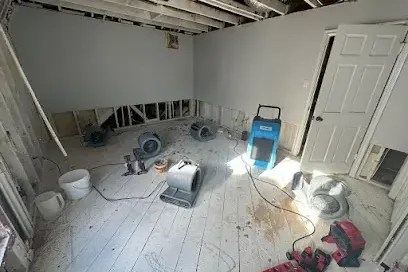
The response team measures moisture in the ceiling, the walls and the floor above. A ceiling leak water damage job often starts by opening the wet drywall.
Insulation that soaked up water is removed, and joist bays are dried with air movers and dehumidifiers.
Ceilings that have sagged are cut open early. Waiting can let the drywall collapse or the insulation grow heavy with water.
Floors above a wet ceiling are checked as well. A leak that began in a bathroom can wet the subfloor, the cabinet base and the wall behind the tub.
A condominium wall often shares framing with the unit next door, so drying readings are taken carefully along shared walls. Equipment is placed so that it dries the wet area without pushing moisture into the next home.
In the unit below
Wet ceiling drywall is cut out so the cavity can dry. Light fixtures in the wet area are turned off until they are checked.
In the unit above
The cause is found and the floor is checked. An appliance leak water damage job also includes drying the area under cabinets and appliances.
Protecting belongings and electrical fixtures
A wet ceiling is also a safety question. Water that has reached a light fixture, a ceiling fan or an outlet can create a shock risk.
A short list helps the household act without taking chances:
- Turn off the breaker for any room with a wet ceiling.
- Do not switch on a light or fan that has water dripping from it.
- Place buckets or tubs under drips and empty them often.
- Cover furniture and electronics with plastic.
- Poke a small hole in a bulging ceiling only if a professional says it is safe, so trapped water can drain.
Furniture and floors below
Move a sofa or a bed away from the wet area. Carpet and rugs under a drip can stain or hold moisture.
Items in cabinets above
If the leak began in a kitchen or laundry area, cabinets in the unit above can hold hidden water. The cause of the leak is traced before cabinets are put back in use.
Owners and renters
In 2010, 69.2 percent of occupied housing units here were owner-occupied and 30.8 percent were rented. A renter should tell the owner right away and keep a copy of the photos.
Landlords and owners can then decide who handles the repair and the claim.
Renters often carry their own policy for belongings. That coverage may help with damaged furniture, even if the building policy covers the structure.
After the drying is done
Once readings are normal, the ceiling is repaired and painted. The work can be coordinated with the association.
The community hub page lists the services offered in the area.
Before repairs begin, the team confirms that readings are normal and that no damp spots remain behind the new drywall. This protects the new finish and prevents a second round of work.
Repairs and painting
After drying, new drywall is hung, taped and painted. Matching the existing paint takes a little care, especially on a large ceiling.
Questions
Who pays when a leak upstairs damages a unit below?
That depends on the cause and on the policies involved. Each household's insurer and the building association can explain the rules.
Should a stained ceiling be painted over?
No. A stain means the cavity above is wet. The drywall and insulation need to be checked and dried first.
Can the ceiling dry without being opened?
Sometimes, if readings are low. Often the drywall is opened so the joist bays can dry.
How long does the drying take?
Drying usually takes several days. Readings decide when it is finished.
Is Las Flores a city?
No. Las Flores is an unincorporated community and census-designated place in Orange County.
Is a wet ceiling a safety risk?
It can be. Water near light fixtures, fans and outlets can create a shock hazard, so the breaker for that room is turned off.
Do renters need their own insurance?
Renters often carry a policy for belongings, which can help with damaged furniture and personal items.