Coto de Caza is a guard-gated, unincorporated community of about 4,000 homes. Larger homes and a gated entrance change how a water loss is handled.
Key takeaways
- Coto de Caza is an unincorporated community and census-designated place, not a city.
- Arranging entry through the gate in advance keeps a response moving.
- Large floor plans let a leak travel through several rooms before it is seen.
- Hardwood floors react quickly to moisture, so readings decide whether boards stay or come up.
- Equipment is staged across wide spaces and monitored until readings are normal.
A guard-gated community
Coto de Caza sits in the northern part of Wagon Wheel Canyon in southeast Orange County. It is guard-gated, and the area is patrolled by the California Highway Patrol, the Orange County Sheriff's Department and the Coto de Caza security force.
Thomas F. Riley Wilderness Park, a county-run sanctuary, surrounds the community on its eastern, northern and southern borders.
A visit by a restoration team is easier to plan when the gate has the details in advance. Equipment trucks, hoses and extension cords all need a clear path to the door.
Why the gate matters in an emergency
A restoration team has to be let in. Telling the gate who is expected, and sharing the property details with the people who need them, avoids delays at the entrance.
Working with the associations
The community has three homeowner associations. Their contacts are worth keeping handy before a loss happens.
How a leak moves through a large home
Larger, lower-density homes have long runs of pipe and many rooms. A small leak can wet several rooms before it is noticed.
A water heater, a dishwasher or an upstairs bathroom is often the starting point.
Large homes also tend to have more fixtures that can fail: extra bathrooms, wet bars, laundry rooms and utility closets. Each one is a possible starting point, and the leak may be found far from where the damage shows.
- Water travels along hallways and under doors.
- Baseboards and cabinet bases wick moisture upward.
- Multiple floors let water drop from one level to the next.
- Rarely used rooms can hide a leak for days.
Second floors and open stairways
Water from an upstairs bathroom can run down a stairwell wall or drip through a light fixture in a high ceiling. Tall spaces make it hard to see the ceiling stain until it spreads.
Staining often appears first around recessed lights and vents, which give the water an easy path out.
Protecting furnishings and valuables
Large homes hold more furniture, rugs, art and stored boxes, and water finds all of it. A quick decision about what to move first saves a lot of heartache.
The response team can help sort items into groups: what can stay, what should be lifted, and what needs professional drying.
- Lift rugs and small furniture off wet floors and place them on foil or plastic.
- Pull books, papers and photos out of low cabinets and shelves.
- Take electronics and cords away from wet areas and outlets.
- Leave heavy furniture where it stands and put blocks under the legs.
- Keep a written list of everything that was wet for the claim.
Rugs and soft goods
Wool and silk rugs hold water and can stain hardwood beneath them. They are best rolled or lifted early and dried flat.
Art and framed items
Frames and canvases should be taken to a dry room and kept upright. Contact a conservator for anything valuable that was wet.
Hardwood floors and moisture
Wood absorbs moisture and swells. Boards can cup, crown or buckle as the water works through them.
A hardwood floor water damage job starts with readings, not guesses.
Wide plank floors across several rooms can hide a problem for a while. Cupping often shows first near a wall or at a doorway, where water pooled before it spread.
Drying in place
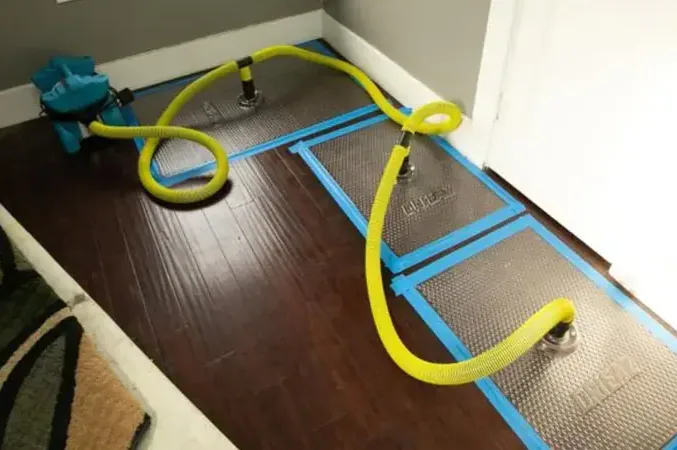
If readings are low and the floor is still flat, boards may be dried where they are. Mats and equipment pull moisture from the surface and from underneath.
Lifting boards
When water is trapped under the floor, boards are lifted so the subfloor can dry. Boards that are not damaged can sometimes be reinstalled.
Drying a wide space
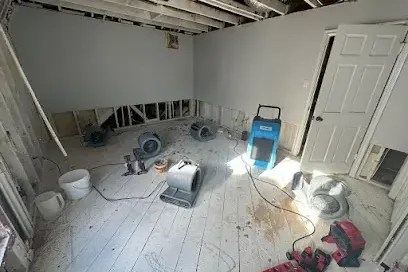
A big room needs more air movement and more dehumidification than a small one. The structural drying plan sets equipment so that air flows across wet surfaces.
Readings are taken at each visit, and equipment is moved as areas dry.
Open floor plans make it harder to keep dry air in one place. Plastic sheeting or closed doors can help create a smaller zone that dries faster.
- Air movers are aimed along walls and floors.
- Dehumidifiers are sized to the volume of air in the wet area.
- Doors and vents are adjusted to keep moist air from spreading.
- Moisture maps track progress room by room.
Monitoring from room to room
The drying team records readings in each room and compares them with a dry reference. Wet areas that stay high are given more air movement.
Equipment is moved as rooms dry, so the same machines can work through the whole house.
- Readings are taken at the floor, the wall base and the ceiling.
- A thermal camera helps find wet spots behind walls.
- Notes are kept for every visit to support the claim.
Owners and documentation
The 2010 census counted 4,853 housing units here, and 91.7 percent of occupied units were owner-occupied. Most losses therefore involve an owner and an insurer.
Photos, a written log and equipment readings support a claim.
A binder or digital folder with the photos, the readings and the invoices keeps everything in one place. Large homes often involve several trades, and one record helps all of them.
What happens after drying
Once the structure is dry, damaged flooring, drywall and cabinets can be repaired. Permits for repairs in unincorporated areas come through OC Development Services of Orange County.
The Coto de Caza page lists the services available in the community.
Rebuilding finishes
Once readings are normal, damaged drywall, trim and flooring are rebuilt. Matching a large hardwood floor or a custom finish takes planning.
Samples of existing floors and paint help the repair blend in.
Questions
Is Coto de Caza a city?
No. It is an unincorporated community and census-designated place in Orange County.
How does gate access work for a restoration team?
Owners tell the gate who is expected. Arranging this in advance helps the team reach the home without delay.
Can hardwood floors be saved after a leak?
Sometimes. Readings decide whether boards can be dried in place or must be lifted.
Why do large homes take longer to dry?
There is more air to condition, more material to dry and more rooms to monitor.
Who issues permits for repairs?
Because the community is unincorporated, building permits come from OC Development Services.
What belongings should be moved first?
Small furniture, rugs, paper items and electronics come first. Heavy pieces stay put and get blocks under the legs.
Can drying equipment run overnight in a large home?
Yes. Drying equipment is built to run for long stretches, and the team checks it at each visit and adjusts it as rooms dry.